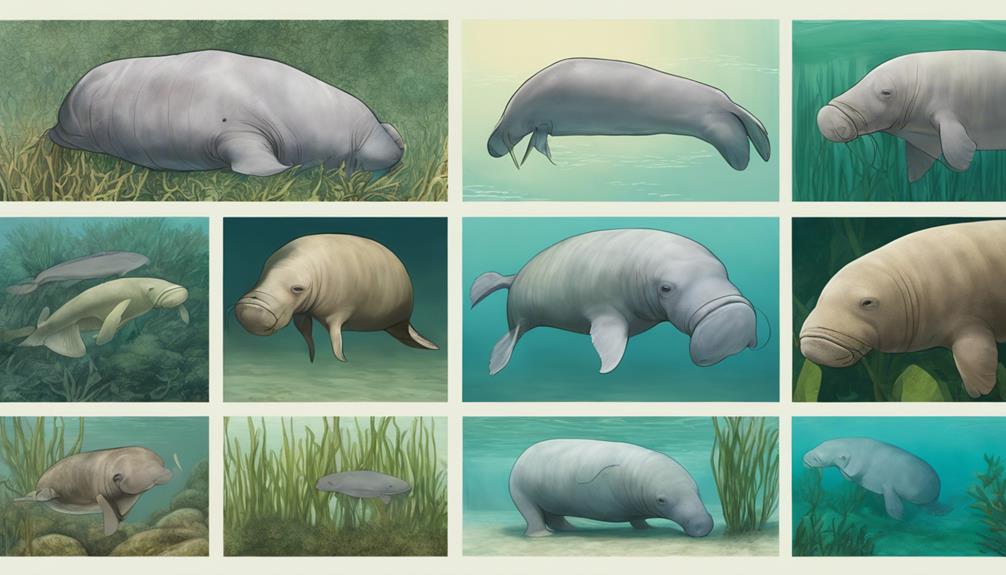
Dugongs vs manatees differ in several significant ways. For instance, dugongs are generally smaller and have fluked tails, while manatees boast paddle-shaped tails. Inhabiting distinct environments, dugongs prefer shallow coastal waters filled with seagrasses, whereas manatees thrive in freshwater and brackish areas. Their diets also vary: dugongs focus on specific seagrasses, while manatees eat a broader range of vegetation. Socially, dugongs tend to be solitary, unlike the more sociable manatees. Both species face unique threats and possess different lifespans and cultural significances. Exploring their differences reveals deeper insights into their roles in marine ecosystems.
Table of Contents
Physical Appearance
When comparing the physical appearance of dugongs and manatees, you’ll notice distinct features that set these marine mammals apart. Dugongs, often referred to as “sea cows,” have a more streamlined body, typically measuring about 8 to 10 feet in length, while manatees can grow larger, reaching up to 13 feet. This size comparison highlights the dugong’s relatively smaller stature.
In terms of color variations, dugongs generally exhibit a grayish-brown hue, sometimes with lighter patches, which helps them camouflage in sandy environments. Manatees, on the other hand, tend to have a more uniform gray coloration, with some individuals displaying a greenish tint due to algae growth on their skin. This difference in coloration isn’t just aesthetic; it plays a vital role in their survival, as it aids in blending into their respective habitats.
Both species exhibit a robust, rounded body shape, but their tails differ significantly. Dugongs possess a fluked tail similar to that of whales, while manatees have a paddle-shaped tail.
These variations in physical traits not only enhance their adaptability to different marine environments but also reflect their evolutionary paths.
Habitat Preferences
Dugongs and manatees not only differ in physical appearance but also in their habitat preferences. Understanding these differences is crucial for conservation efforts. Here are three primary distinctions:
- Dugongs prefer shallow coastal waters and seagrass beds, often found in the Indian and western Pacific Oceans.
- Manatees, on the other hand, inhabit a variety of freshwater, saltwater, and brackish environments, thriving in rivers, estuaries, and coastal areas across the Americas and West Africa.
- Both species rely heavily on specific breeding grounds to ensure healthy populations.
These habitat choices impact their vulnerability to environmental threats. Dugongs are sensitive to habitat degradation caused by coastal development and pollution, which can destroy essential seagrass beds.
Meanwhile, manatees face threats from boat collisions and habitat loss, often linked to freshwater system alterations.
Feeding Habits
When examining the feeding habits of dugongs and manatees, you’ll notice distinct differences in their diet composition, grazing techniques, and preferred feeding habitats.
Dugongs primarily consume seagrass, while manatees have a more varied diet that includes both seagrass and other aquatic plants.
Understanding these variations can provide insight into their ecological roles and the habitats they occupy.
Diet Composition Differences
In the world of marine herbivores, you’ll find distinct differences in the diet composition of dugongs and manatees. Understanding these differences is crucial for conservation efforts and habitat management. Here are three key points to consider:
- Nutritional Preferences: Dugongs primarily consume seagrasses, while manatees have a more varied diet that includes both seagrasses and freshwater vegetation.
- Dietary Adaptations: Dugongs are adapted to graze on specific types of seagrass, reflecting their habitat preferences, whereas manatees can thrive in a wider range of environments, benefiting from diverse food sources.
- Feeding Behavior: The feeding habits of these two species influence their nutritional intake and, ultimately, their health and reproductive success.
Dugongs focus on high-quality seagrass species, which provide essential nutrients but are limited in availability.
In contrast, manatees can adapt their diet based on food availability, allowing them to thrive in various ecosystems.
These dietary adaptations enable them to occupy different ecological niches, underscoring the need for tailored conservation strategies that consider their unique nutritional preferences and habitat requirements.
Grazing Techniques Variations
Understanding the nuances of feeding habits reveals how dugongs and manatees employ different grazing techniques to obtain their nourishment. Dugongs primarily focus on seagrass, using a methodical approach to graze. Their grazing patterns include uprooting seagrass with their strong flippers and snouts, allowing them to consume large amounts in a single sitting. This technique enables them to thrive in sandy, shallow waters where seagrass is abundant.
In contrast, manatees exhibit a more varied feeding technique. They tend to nibble on a broader range of aquatic plants, engaging in a more selective grazing pattern. Manatees use their sensitive lips to pluck softer vegetation, often consuming both seagrass and other aquatic flora. This adaptability allows them to exploit different food sources based on availability, making their feeding habits more versatile.
Both species play crucial roles in their ecosystems, but the differences in their grazing techniques significantly impact their ecological niches. By understanding these variations, you can appreciate how each species contributes uniquely to the health of marine environments and the importance of protecting their respective habitats.
Feeding Habitats Distinctions
Dugongs and manatees inhabit distinct feeding environments that significantly influence their dietary habits. Understanding these differences is crucial for appreciating their roles in marine ecosystems:
- Dugongs primarily graze on seagrass beds in coastal waters.
- Manatees prefer shallow, freshwater habitats and mangrove ecosystems.
- Both face challenges from habitat degradation.
Dugongs are specialized herbivores, relying on seagrass beds for nutrition. Their feeding behavior helps maintain healthy aquatic vegetation, promoting nutrient cycling and supporting diverse marine life.
They play a vital role in their ecosystem, as their grazing patterns prevent seagrass overgrowth and enhance biodiversity.
In contrast, manatees exhibit more varied feeding habits, consuming both seagrass and other aquatic vegetation. Their presence in mangrove ecosystems allows them to interact with a broader range of herbivorous interactions, influencing the health of these crucial habitats.
However, both species are threatened by environmental impacts, such as habitat degradation from coastal development and pollution.
Protecting their feeding habitats is essential for maintaining their populations and the ecological balance they help uphold.
Tail Shape
When you compare the tail shapes of dugongs and manatees, you’ll notice distinct differences that reflect their adaptations to swimming and habitats.
Dugongs possess a fluked tail, enhancing their agility in open waters, while manatees have a more rounded tail, suited for maneuvering in coastal areas and rivers.
These structural variations not only influence their swimming techniques but also play a crucial role in their survival in varying environments.
Tail Structure Comparison
Both dugongs and manatees exhibit distinct tail structures that play a crucial role in their swimming abilities. Understanding these differences can help you appreciate how each species has adapted to its environment over time.
Here are three key points about their tail structures:
- Tail Shape: Dugongs have a fluked tail resembling that of a whale, designed for powerful propulsion through water. Manatees, on the other hand, possess a more rounded, paddle-like tail that aids in maneuverability.
- Tail Function: The tail function of these marine mammals reflects their evolutionary paths. Dugongs, primarily grazers of seagrass, benefit from their streamlined tails for swift movement across open waters. In contrast, manatees often navigate through shallow coastal areas, where a broader tail enhances their ability to steer.
- Tail Evolution: Over time, both species have evolved tails that suit their specific habitats and feeding behaviors, showcasing the remarkable adaptability of marine life.
Swimming Adaptations
Understanding the swimming adaptations of dugongs and manatees reveals how their tail shapes directly influence their movement in water.
Dugongs possess a fluked tail, similar to that of a whale, which allows for powerful propulsion and greater swimming efficiency. This tail design enables dugongs to navigate through their underwater habitats with agility, making them adept at covering distances and foraging for seagrass.
In contrast, manatees have a rounded, paddle-like tail that provides a different type of propulsion. This tail shape allows for more controlled and gentle movements, which is beneficial in slower-moving waters. While this adaptation enhances their ability to graze on aquatic vegetation, it may limit their speed compared to dugongs.
Both species exhibit unique breathing adaptations that complement their swimming techniques. Dugongs can hold their breath for longer durations, allowing them to dive deeper and swim longer distances.
Manatees, however, surface more frequently, utilizing their wide tails to generate a stable lift, facilitating their rise to the surface for air.
Ultimately, the differences in tail shape between dugongs and manatees play a crucial role in their respective swimming adaptations and overall efficiency in their aquatic environments.
Habitat Influences
Influencing their habitats, the distinct tail shapes of dugongs and manatees reflect adaptations to their respective environments. Understanding these differences can enhance your appreciation for these marine mammals and the ecosystems they inhabit.
Here are three key factors to consider:
- Tail Structure: Dugongs possess a fluked tail, similar to that of a whale, which aids in powerful propulsion through deeper waters. This shape is beneficial in navigating the coastal ecosystems where they often feed on seagrass.
- Swimming Patterns: Manatees have a rounded, paddle-like tail that promotes slower, more deliberate movements. This design is well-suited for the warmer, shallower waters they frequent, allowing them to graze on aquatic vegetation efficiently.
- Adaptation to Water Temperature: Both species thrive in specific water temperature ranges, with manatees preferring the warmer, coastal areas, while dugongs can tolerate a broader range of temperatures.
These distinct tail shapes not only influence their swimming abilities but also reflect their adaptations to the unique challenges of their habitats, ultimately contributing to the health of coastal ecosystems.
Social Behavior
Dugongs and manatees frequently exhibit distinct social behaviors that reflect their adaptations to different environments. Dugongs tend to display more solitary behaviors, often foraging alone or in small groups, which influences their group dynamics. In contrast, manatees usually gather in larger herds, fostering complex social interactions. Their communication methods include subtle vocalizations and body language, enhancing their ability to navigate social hierarchies.
Parental care is another area where their behaviors diverge. Manatees are known for their strong maternal bonds, often seen nursing their young in social settings, while dugong mothers may be less engaged in communal rearing practices. This difference can be crucial for survival, as it shapes their offspring’s development within varying group dynamics.
When it comes to mating rituals, both species exhibit unique behaviors that can lead to territorial disputes, particularly among male dugongs. These disputes can affect herd behavior, as males may assert dominance to gain access to mates.
Reproductive Strategies
Social structures play a significant role in shaping the reproductive strategies of both dugongs and manatees. Understanding these strategies is vital for enhancing conservation efforts. Here are three key aspects to consider:
- Mating Rituals: Both species exhibit distinct mating rituals that influence their breeding behaviors. Dugongs tend to have more pronounced courtship displays, while manatees often engage in gentle interactions.
- Gestation Periods: The gestation period for dugongs averages around 13 months, while manatees typically gestate for about 12 months. These durations significantly affect reproductive cycles and population dynamics.
- Parental Care: Dugongs and manatees both demonstrate strong parental care, which is crucial for offspring survival. Mothers nurse their young extensively, ensuring the longevity of the species.
These reproductive strategies not only impact individual species but also contribute to broader ecological dynamics.
Distribution Range
Typically found in warm coastal waters, both dugongs and manatees have distinct distribution ranges that reflect their ecological needs and habitat preferences. Dugongs primarily inhabit the shallow waters of the Indo-Pacific region, often residing near seagrass beds, which are crucial for their diet. Their migration patterns are somewhat limited, usually dictated by the availability of food sources and environmental conditions.
In contrast, manatees are found in the freshwater and coastal environments of the Caribbean, North America, and parts of South America. Their distribution can span brackish and freshwater areas, showcasing their adaptability.
Population densities of both species vary by region. For instance, manatees tend to have higher population densities in areas with abundant warm water, such as natural springs, especially during colder months. Dugongs, however, may exhibit more localized populations, often concentrated in specific seagrass habitats.
Understanding these distribution patterns is essential for conservation efforts, as it enables you to identify critical habitats and migratory routes that need protection. By serving these marine mammals through informed conservation strategies, you’ll contribute to the preservation of their ecosystems and, ultimately, their survival.
Conservation Status
Both dugongs and manatees face significant threats, leading to their classification as endangered species.
Understanding their conservation status involves examining the specific efforts aimed at protecting each species and the effectiveness of these initiatives.
You’ll find that while both groups share common challenges, their conservation strategies differ in focus and execution.
Endangered Species Status
How do the conservation statuses of dugongs and manatees reflect their vulnerability in today’s ecosystems? Both species face significant threats, making their conservation a priority. Understanding their status is crucial for effective protection efforts. Here are three key points to consider:
- Population Trends: Dugongs are classified as vulnerable, with populations declining due to habitat loss and hunting. Manatees, while also facing challenges, have seen some recovery due to conservation efforts, yet they remain threatened.
- Legal Protections: Dugongs are protected under various international agreements, but enforcement is often weak. Manatees benefit from stronger legal protections in the United States, including the Marine Mammal Protection Act and the Endangered Species Act.
- Habitat Loss: Both species rely on seagrass beds, which are diminishing due to coastal development and pollution. This habitat loss directly impacts their survival and reproduction.
Conservation Efforts Comparison
In examining the conservation efforts for dugongs and manatees, it’s clear that both species require targeted interventions to ensure their survival. You’ll find that effective threat assessments are crucial in understanding the unique challenges faced by each species.
For dugongs, the primary threats often stem from habitat degradation due to coastal development and human impact, while manatees frequently contend with boat strikes and water pollution.
Habitat restoration is essential for both, but approaches vary. Dugong conservation often focuses on seagrass recovery, whereas manatee protection may include restoring warm-water habitats.
Public awareness campaigns are vital for engaging communities, as informed citizens can advocate for policy development that supports these marine mammals.
Research funding plays a significant role in species monitoring, enabling scientists to track populations and assess the effectiveness of conservation strategies.
Community involvement is also paramount; local stakeholders can contribute significantly by participating in conservation activities and promoting sustainable practices.
Ultimately, both dugongs and manatees need a collaborative approach that combines scientific research, community action, and robust policy frameworks to thrive in an increasingly human-dominated world.
Lifespan Differences
The lifespan of dugongs and manatees reveals significant differences that reflect their unique adaptations and environmental challenges. Understanding these age differences can help you appreciate the lifespan factors influencing each species. Here are three key aspects to consider:
- Lifespan: Dugongs can live up to 70 years, while manatees typically have a lifespan of 50 to 65 years.
- Reproductive Age: Dugongs reach sexual maturity around 8 to 10 years, while manatees usually mature later, between 5 to 7 years.
- Environmental Threats: Factors such as habitat loss, hunting, and climate change impact their longevity differently, affecting dugongs more severely due to their coastal habitat reliance.
These lifespan factors not only highlight the natural variations between dugongs and manatees but also emphasize the need for targeted conservation efforts.
Cultural Significance
Dugongs and manatees hold significant cultural importance in various communities, particularly in coastal regions where they inhabit. These marine mammals embody cultural symbolism, serving as vital components of local folklore and traditions.
For instance, many indigenous beliefs regard dugongs as spiritual beings, often associated with creation myths and ancestral stories that emphasize harmony with nature.
In several cultures, manatees are seen as symbols of gentleness and nurturing, reflecting the community’s values of care and respect for the environment. Their presence can inspire conservation efforts, reminding people of the interconnectedness of life.
As you explore these cultures, you’ll find that both dugongs and manatees play essential roles in educational programs aimed at promoting environmental stewardship.
Moreover, these species often feature in art and storytelling, reinforcing their significance in cultural identity.
By understanding the cultural symbolism surrounding dugongs and manatees, you can appreciate how these animals shape community values and foster a sense of belonging among indigenous people.
This awareness not only enriches your understanding of marine life but also highlights the importance of preserving these creatures for future generations.
Frequently Asked Questions
How Do Dugongs and Manatees Communicate With Each Other?
Dugongs and manatees communicate through vocalization patterns and body language. You’ll notice they use sounds to express needs and emotions, while their movements convey social interactions, helping you understand their behaviors and relationships in the wild.
What Are the Main Predators of Dugongs and Manatees?
Dugong predators mainly include sharks and killer whales, while manatee threats come from crocodiles and large sharks. Understanding these dangers helps you appreciate the conservation efforts needed to protect these gentle marine mammals.
Can Dugongs and Manatees Hybridize?
You might wonder if dugongs and manatees can hybridize. While their reproductive barriers often prevent this, hybrid viability remains a topic of interest, sparking curiosity among scientists about the potential for unique offspring in mermaid waters.
What Roles Do Dugongs and Manatees Play in Their Ecosystems?
You’ll find that dugongs and manatees play crucial roles in their ecosystems through their herbivorous habits, promoting seagrass growth. Their habitat preferences also influence local biodiversity, supporting various marine species and maintaining ecological balance.
How Have Climate Change and Pollution Affected These Species?
As the canary in the coal mine, dugongs and manatees suffer from habitat loss and declining water quality, revealing how climate change and pollution threaten their survival. You can advocate for cleaner ecosystems to protect them.
Conclusion
In understanding the key differences between dugongs and manatees, you uncover fascinating insights into their unique adaptations and ecological roles. Both species, though often confused, thrive in distinct habitats and exhibit varied behaviors that reflect their evolutionary paths. Coincidentally, their similarities highlight the importance of marine conservation. By recognizing these nuances, you can appreciate not just their individual significance, but also the delicate balance of the ecosystems they inhabit, urging further efforts to protect these remarkable marine mammals.